
Rumi’s Gift: A Teacher Training on Listening Builds Resilience, Strengthens Communities, and Promotes Personal Healing
Marium is the recently widowed mother of two girls. She feels grateful to have a job as a teacher of small children at a salary that leaves her on the brink of poverty, but at least allows her to pay school fees for her daughters.
Her life has not been easy. It is a familiar story in the impoverished neighborhoods of Peshawar. Her late husband had been unemployed, despondent, addicted to methamphetamine, and inclined to express his explosive anger with acts of domestic violence. He frequently bullied his wife for money to feed his addiction.
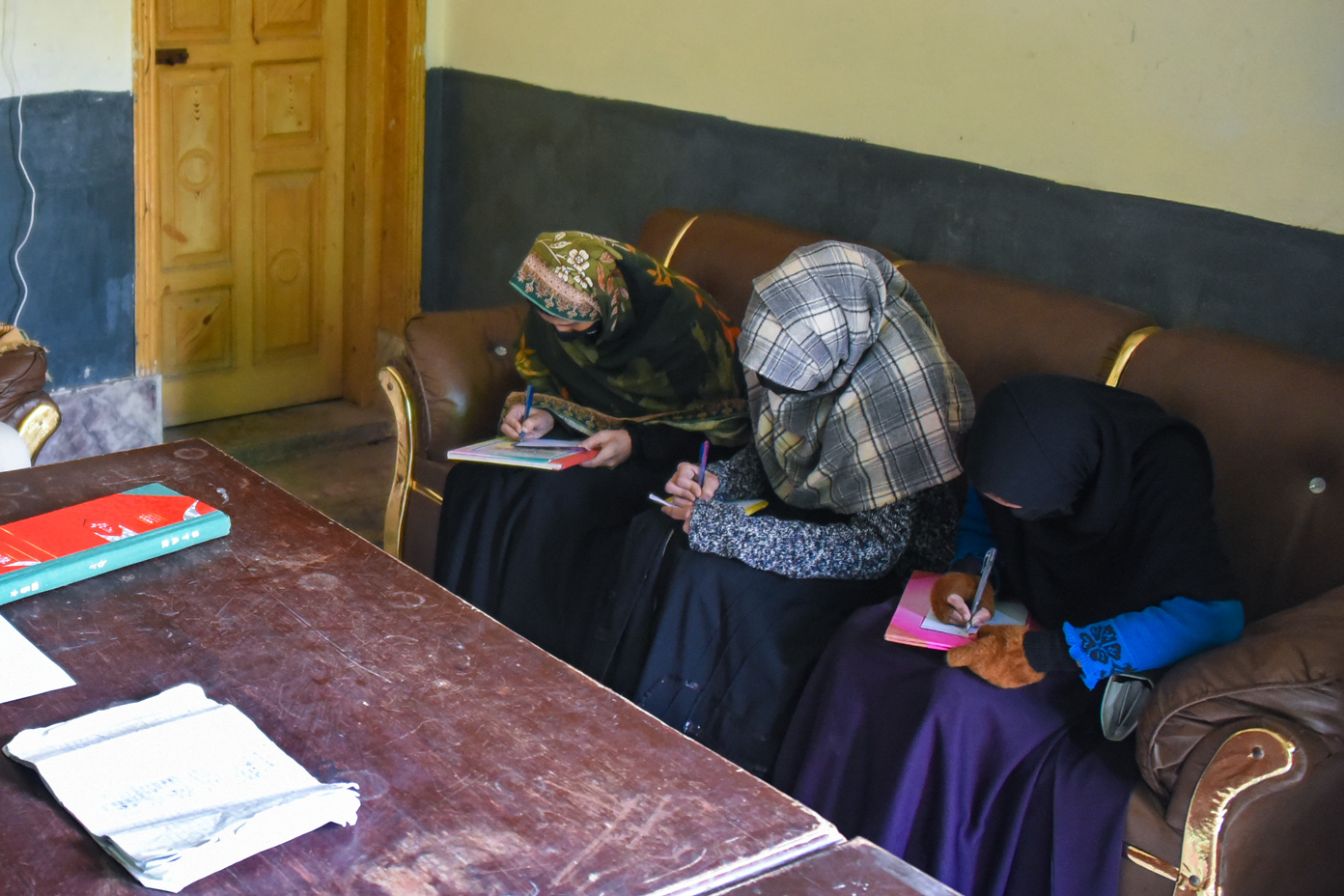
As part of her employment, Marium recently attended a teacher training which was designed by Brighter Tomorrow to give teachers listening skills, which are basic to providing the children with psychosocial support and a healthy learning environment. The training also encouraged the teachers to use these same skills to listen to themselves, their families, and their communities, and to initiate a broader process of community-based psychosocial support.
There were many interesting exercises. Their teacher, Wajid, used clips from a Bollywood movie to illustrate common stress responses such as freeze, fight, and flight, which led to a discussion of the differences between healthy (positive) stress and unhealthy (negative) stress. Resilience was demonstrated through a hands-on green stick/dry stick activity. And a sense of emotional balance was found by making two piles of pebbles. In one pile each pebble represented a worry or a trouble. In the other, the pebbles represented things in their lives for which they felt gratitude. The participants discovered that although their troubles were numerous, they could always find one more thing to feel grateful for.
Participants discussed how stress affects children, teachers, and families. They learned that good listening can help mitigate unhealthy stress, preventing crises that can lead to serious psychological difficulties that require expensive psychiatric support services, which are largely unavailable to the children and families that Brighter Tomorrow serves.
To deepen understanding, facilitators demonstrated examples of poor listening and effective listening. Participants were then divided into pairs to practice both styles and reflect on their experiences in small groups. Many teachers shared that it was difficult to refrain from giving advice to the storyteller. However, the exercise showed them how powerful and beneficial it was simply to listen attentively, reflect without judgment, and remain present. Participants noted that they felt most fully heard when the listener gently asked, “Is there anything more you would like to share?”
This exercise helped participants appreciate how good listening fosters trust, emotional safety, and deeper connection – skills essential for supporting children and families facing distress. This understanding will enable teachers to better support the children of Brighter Tomorrow, while also strengthening mutual support among themselves and within their communities.
At the end of the session, participants were introduced to the concept of “helping the helpers” and the importance of teachers supporting themselves and one another through Focusing techniques.
The Pashto translation of Rumi’s poem “The Guest House” was read to the class. Then through a guided exercise, participants were led to reach a quiet, calm inner space where they could welcome their “inner guests” and reflect on their inner experiences, building greater self-awareness and emotional resilience. Many teachers described the experience as deeply moving. They discovered that their calm space inside could become a place of healing.
When Marium found her calm space and turned to welcome her personal “guests”, something wonderful happened. Marium had begun the day weighed down by a decision she had made. She is an educated woman, and this decision was not an easy one, not something she wanted. But she could see that it was necessary, and it had made her heart ache. During the Guest House exercise, she opened her heart to welcome her worries, to accept the sadness inside as well as other guests that made her happy.
As the group gathered afterwards to discuss what happened to them during the exercise, Marium described a lightness that had come to her. A smile broke out on her face, and she surprised herself and everyone else by gigging.
We cannot know exactly what occurs in another’s heart. Perhaps as Marium sat with all that she found inside, she recognized the pebbles from the balance exercise – some of them representing her problems, but even more marking the things for which she was grateful. Perhaps she recognized her difficult decision as an instance of her choosing the path of flexibility represented by the green stick – of choosing a new path forward when faced by obstacles instead of holding rigidly to former hopes.
Or perhaps she had simply felt the cleansing power of welcoming “a crowd of sorrows…clearing out” her inner space.
What she said through her laughter was that she had not known how very many guests there were inside her. What her friends saw was that she understood herself in a new way. No wonder she was so beset with worries! Her life had changed dramatically when her husband died. She was relieved, of course, to know he would not be badgering her for the little money she earned and hitting her when he felt angry at the desperation of his life. But she also felt a great sorrow, a sense of abandonment, and a deep-seated fear since a woman without a husband was an easy target in the impoverished community in which she lived.
In discussions with other class participants during the course of the day, Marium had shared her reluctant decision to marry off her daughters as soon as possible. In a quiet moment, Wajid questioned her about it. Her daughters were only 14 and 17. “Do you think they are old enough to be married?” he asked.
“It is not what I would have wished,” she replied. “I live just around the corner. Come with me and you will understand.”
She introduced him to her daughters.
“I understand,” Wajid said. Both girls were not merely attractive, but breathtakingly beautiful. Without a father, or even a brother, in the home to protect them, it would only be a matter of time until someone assaulted them, ruining their lives, destroying their chances of a family or a career, dooming them to lives of poverty and shame.
“I know it is against the law for me to marry them off so young,” the resilient Marium said. “And I will go to jail gladly, if necessary, to save them from such a fate.” And she smiled at him with the full force of her new lightness of being.